Flags of the Dutch Caribbean
Six islands that once made up the Netherlands Antilles, each flying its own flag since the federation broke up.
6 flags8 sourcesFlag images: Flagpedia and Wikimedia Commons · creditsSuggest a correction
Aruba left the Netherlands Antilles in 1986, and the rest of the federation was dissolved in 2010. Aruba, Curaçao and Sint Maarten are now countries within the Kingdom of the Netherlands; Bonaire, Saba and Sint Eustatius are special municipalities of the Netherlands itself.
While the federation lasted, all six islands flew one flag, adopted in 1959: white, crossed by a red and a blue band, with a star on the blue for each island. When Aruba left, the flag dropped to five stars and kept them until the end. By then every island already had its own flag, all adopted between 1976 and 2004, and since 10 October 2010 those are the only ones flown.
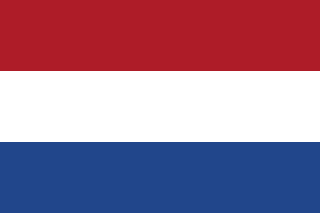
Sint Maarten, Saba and Sint Eustatius keep the Dutch tricolour's red, white and blue in their flags, while Aruba, Curaçao and Bonaire all bring in yellow.
Countries within the kingdom
The three islands that govern themselves, each with its own parliament and prime minister.
Aruba
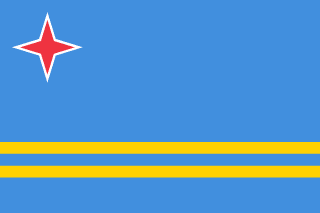
First raised on 18 March 1976, ten years before Aruba left the federation, and the date is still Aruba's Flag Day. Two thin yellow stripes run across the lower half of a light blue field, below a white-edged red star with four points.
On the globe →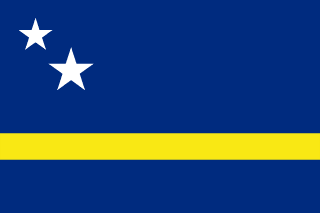
Curaçao
Adopted on 2 July 1984, now Curaçao's Flag Day. A yellow band for the sun runs low across the blue of sea and sky, and the two white stars stand for Curaçao itself and Klein Curaçao, its uninhabited neighbour.
On the globe →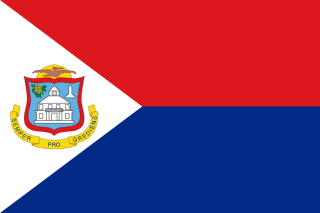
Sint Maarten
Dating from 1985, the flag sets the island's arms in a white triangle against red and blue halves. The arms show the courthouse in Philipsburg and the monument to its peaceful division with French Saint-Martin, agreed in 1648.
On the globe →
Special municipalities
The three smaller islands, now part of the Netherlands proper, with flags kept from their days in the federation.

Bonaire
Adopted in 1981. Yellow above and blue below meet at a white diagonal band, with a black compass rose around a six-pointed star in red.
On the globe →
Saba
Adopted in 1985 for an island of about 13 square kilometres. A gold star sits in a white diamond at the centre, between red triangles above and blue ones below.
On the globe →
Sint Eustatius
The youngest of the six, from 2004, raised on Statia Day, 16 November. That date recalls 1776, when the island's fort returned a salute from an American ship, one of the first salutes any foreign power gave to the flag of the newly declared United States.
On the globe →
On the globe
 Netherlands
More flags
- Argentina’s province flags
- Australia’s state and territory flags
- Belgium’s regional and provincial flags
- Brazil’s state flags
- Canada’s provincial and territorial flags
- Flags of autonomous regions and islands
- Flags of disputed territories
- Flags of former countries
- Flags of international organizations
- Flags of the British Overseas Territories and Crown Dependencies
- Flags of the world
- France’s regional and overseas flags
- Germany’s state flags
- Ireland’s province flags
- Italy’s regional flags
- Japan’s prefectural flags
- Liberia’s county flags
- Mexico’s state flags
- Russia’s regional flags
- Spain’s regional flags
- Switzerland’s canton flags
- The Netherlands’ province flags
- U.S. state flags
Sources
- [1]Flag of the Netherlands Antilles · Encyclopaedia Britannica
The 1959 flag, its six stars cut to five in 1986, and its retirement on 10 October 2010.
- [2]Aruba · Flags of the World
The island council's resolution of 16 March 1976 and the first hoisting on 18 March.
- [3]Curaçao · Flags of the World
- [4]
- [5]
- [6]
- [7]Sint Eustatius · Flags of the World
Approved by the island council on 29 July 2004 and first hoisted on 16 November 2004.
- [8]Salute at 'Statia (Phillips Melville) · U.S. Naval Institute Proceedings · 1961-06
Fort Oranje's salute to the Andrew Doria on 16 November 1776, flying the Grand Union flag before the Stars and Stripes existed.
Map geometry from Natural Earth via world-atlas. See credits.